

Maybe this would be helpful to find out how it works? 
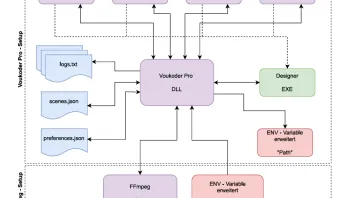
(from the Voukoder Pro doc)
Maybe this would be helpful to find out how it works?
(from the Voukoder Pro doc)
Thanks for reminding me. I am looking at it now ...
What template did you select to use for Voukoder Pro? If you want an alpha channel you have to feed the alpha channel into it. Only one template does this in Vegas Pro:
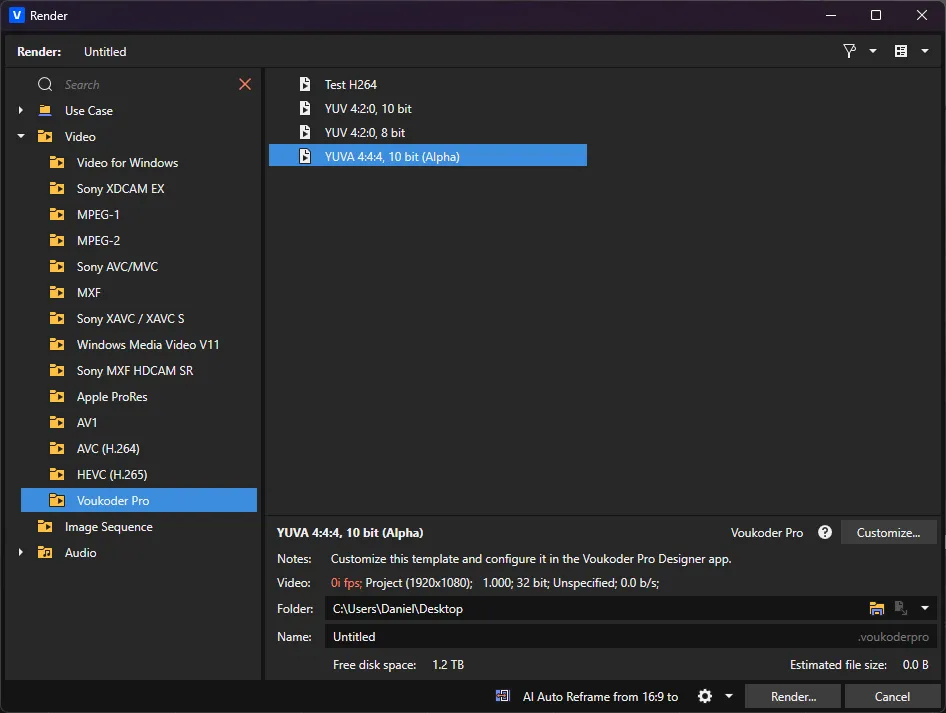
In the Pro version only the bold printed values will be used. In fact if they still match their default values they will be ignored. you can also see the this in the preview: only the values that are mentioned there will be finally applied.
Thank you! I'll keep investigating this issue.
Platforms: Windows x64, Windows ARM64, macOS Apple Silicon Premiere Pro: 26.0+ FFmpeg: 8.x (user-supplied, any build — GPL, LGPL, or custom)
Ingestor is a Premiere Pro importer plug-in that uses your existing FFmpeg installation to bring virtually any media format into your timeline. If FFmpeg can decode it, Ingestor can import it — no transcoding, no intermediate files, no waiting.
165 container families supported out of the box, covering formats Premiere doesn't natively handle.
Format coverage that keeps up with FFmpeg Ingestor discovers formats at runtime from whatever FFmpeg build you have installed. New codecs land in FFmpeg long before Adobe ships native support — now you get them in Premiere the same day you update FFmpeg.
GPU-accelerated decoding (NVDEC, QSV, D3D11VA, VideoToolbox) AV1, HEVC, H.264, and VP9 decode on your GPU through hardware-native decoders — av1_cuvid, hevc_cuvid, h264_cuvid, vp9_cuvid on NVIDIA, QSV on Intel, VideoToolbox on macOS. The plug-in benchmarks each backend per codec and resolution at first import, including the PCIe readback cost, and only uses GPU when it's genuinely faster than CPU. Transparent fallback to software if hardware isn't available or fails mid-stream.
Background prefetch for smooth playback A dedicated prefetch thread decodes up to 16 frames ahead of the playback position into a decoded-frame cache. When Premiere's render threads request those frames, they get a sub-microsecond cache hit instead of waiting for a full decode cycle. Eliminates dropped frames during 4K playback and cuts export time by 20-30% on decode-bound clips.
Configurable frame cache The decoded-frame cache budget is user-configurable via a simple text file (%LOCALAPPDATA%\Ingestor\ingestor.prefs). Set frameCacheMiB=512 for responsive 4K scrubbing, or go higher on systems with RAM to spare. The cache uses deep-copied frames — no GPU memory pool conflicts at any budget size.
HDR done right PQ and HLG sources are delivered through Premiere's 32-bit float pipeline with correct BT.2020 primaries, transfer function, and mastering display metadata. No baked-in tone mapping, no wrong colours — your Lumetri scopes show exactly what's in the file.
10-bit native delivery 10-bit 4:2:0 sources are delivered as P010 biplanar directly into Premiere's native pipeline. No upsampling to 4:4:4, no unnecessary float conversion. Maximum quality with minimum overhead.
Async import with keyframe-aware scheduling Background render threads get their own decoder instances. Premiere's render pipeline can request frames in parallel without blocking the UI. Seek-index acceleration snaps random access to the nearest keyframe for faster scrubbing.
Correct colour, every time ITU-T H.273 colour codes are read directly from the bitstream. Primaries, transfer characteristics, matrix coefficients, and full/limited range are declared to Premiere — not guessed from resolution or assumed to be BT.709.
Three architectures, one binary per platform Native builds for x64, ARM64 (Windows), and Apple Silicon (macOS). SIMD-accelerated conversion kernels (SSE4.2, AVX2, NEON) with scalar fallback. Golden-frame tests ensure byte-identical output across all architectures.
All settings live in a single text file — no registry, no cloud accounts, no activation servers:
Available options:
frameCacheMiB=512           # decoded-frame cache budget (16-4096, default 128)
enableHardwareDecoding=true # GPU decode on/off
logLevel=3 # 0=off, 1=error, 2=warn, 3=info, 4=debugThanks to Schauerland for his extended testing period. This is an early release. If you hit a format that doesn't import cleanly, the plug-in writes a detailed log file with codec info, pixel format decisions, and conversion paths taken. Include that log when reporting issues and I can usually diagnose without needing your media file.
I'll keep you updated.
No, the minimal driver version must be met. Any higher driver version is alright.
2026-08-21 17:11:28 (trace) [FFmpeg:0] dl_fn->cuda_dl->cuCtxCreate(&ctx->cu_context_internal, 0, cu_device) failed
2026-08-21 17:11:28 (trace) [FFmpeg:0] -> CUDA_ERROR_ILLEGAL_ADDRESS: an illegal memory access was encountered
I'm wondering if maybe your GPU is defective. That would explain this error (and it is also not used by VEGAS Pro).
I haven't seen this before.
Thanks, that was helpful!
2026-08-21 17:11:28 (trace)    [FFmpeg:0] Loaded Nvenc version 13.1
2026-08-21 17:11:28 (trace)    [FFmpeg:0] Nvenc initialized successfully
2026-08-21 17:11:28 (trace)    [FFmpeg:0] Calling dl_fn->cuda_dl->cuInit(0)
2026-08-21 17:11:28 (trace)    [FFmpeg:0] Calling dl_fn->cuda_dl->cuDeviceGetCount(&nb_devices)
2026-08-21 17:11:28 (trace)    [FFmpeg:0] 1 CUDA capable devices found
2026-08-21 17:11:28 (trace)    [FFmpeg:0] Calling dl_fn->cuda_dl->cuDeviceGet(&cu_device, idx)
2026-08-21 17:11:28 (trace)    [FFmpeg:0] Calling dl_fn->cuda_dl->cuDeviceGetName(name, sizeof(name), cu_device)
2026-08-21 17:11:28 (trace)    [FFmpeg:0] Calling dl_fn->cuda_dl->cuDeviceComputeCapability(&major, &minor, cu_device)
2026-08-21 17:11:28 (trace)    [FFmpeg:0] [ GPU #0 - < NVIDIA GeForce RTX 3060 > has Compute SM 8.6 ]
2026-08-21 17:11:28 (trace)    [FFmpeg:0] Calling dl_fn->cuda_dl->cuCtxCreate(&ctx->cu_context_internal, 0, cu_device)
2026-08-21 17:11:28 (trace)    [FFmpeg:0] dl_fn->cuda_dl->cuCtxCreate(&ctx->cu_context_internal, 0, cu_device) failed
2026-08-21 17:11:28 (trace)    [FFmpeg:0]  -> CUDA_ERROR_ILLEGAL_ADDRESS: an illegal memory access was encountered
2026-08-21 17:11:28 (trace)    [FFmpeg:0]
2026-08-21 17:11:28 (trace)    [FFmpeg:0] No capable devices found
2026-08-21 17:11:28 (trace) [FFmpeg:0] Nvenc unloadedA few things for you to check:
Please share the MediaInfo where/when you have changed it.
Can you change the "Codec Tag" property from "apch" to "ap4x"?
Can you change the Log File mode to "Trace" level and try again?
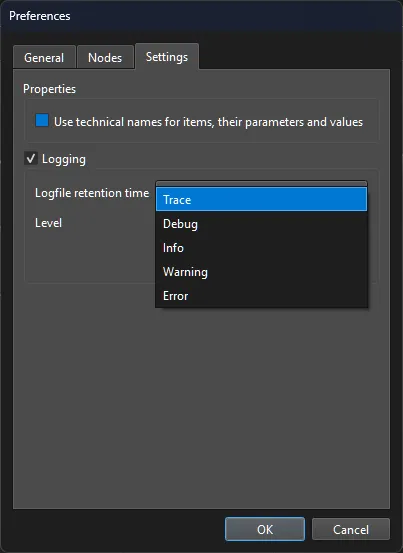
That would give some more information about the actual FFmpeg error code.
Can you please share the MediaInfo of the exported video?
To my knowledge Resolume Alley identifies the codec tag for the correct ProRes variant. Can you test if this build fixes the issue?
https://d.voukoder.org/VoukoderPro-x86_64-2026.2.4.msi
Please try the 2026.2.3 build again. I have reused the same version number.
Yes, I have to add these global parameters manually. Everything else is auto discovered. I'll keep you updated.
If everything is working fine at your side you don't have to test it. This is just addressing issues other people might have.

Does this build help?
VegasSteve I found out Boost changes it in its logging library.
Users having issues like these:
Please try this build and respond here if it works or still fails.
I'll check the snap to grid option. I intentionally disabled the zoom in/out option.
You can change the "open on startup" options in the designer preferences.
What app are you trying to start? This shouldn't happen. Did you install Voukoder Pro Version 2 anytime?